nuffnang code

Monday, May 9, 2016

Busan Day 2: Dalamji-gil Road, Chinatown, Jagalchi Market, BIFF Square


   After spending most of our first day at Gamcheon Art Village, we spent the remainder of our afternoon trying to hunt for other tourist spots around Busan. We ended up at Dalmaji-gil Road near Haeundae Beach, which is famous for its cherry blossom tree-lined roads. We were hoping that they would be already in bloom, but unfortunately there were still no signs of the pretty pink petals we so badly wanted to see. They were in bloom about a week after we left! Talk about bad timing :( 

   But of course we still had to make the most of our situation so we just took a bunch of photos here haha!

   Should you be lucky enough to find yourself in Busan during cherry blossom season, Dalmaji-gil Road is one of the best places to see it. To get here via MRT:

Take subway line #2, get off at Exit 5 or 7 of Jungdong Station.


   We stopped by the Busan Station to check out the rates and schedules for the bullet train to Seoul. Busan's Chinatown is just across the street from the station, but don't expect it to be like Chinatowns in other countries with night markets and food stalls. We got there at around 9 in the evening and most of the souvenir shops were already closed. The only places that were open were seedy bars, massage parlors and a handful of Chinese and Russian restaurants. 


   The next day, we only had a halfday to spend in Busan before heading to Seoul so we decided to go somewhere relatively near Busan Station so we wouldn't go beyond our planned time of departure.

Jagalchi Market and BIFF Square


   Jagalchi Fish Market is Korea's largest seafood market and I was sooo amazed at the variety of seafood on display! All kinds of fish, shells, giant octopus, the list goes on. The wet market surprisingly does not reek strongly of fish (This is subjective; I don't know about you guys, but anybody who has been to a Philippine wet market knows how smelly the fish section is) and we had fun walking around and checking out the stalls.


   We walked a little further towards BIFF (Busan International Film Festival) Square. This area was transformed in 1996 as a center for Korea's film industry and the annual film festival used to be held here until it was transferred to the Busan Cinema Center in 2012. BIFF Square still attracts a lot of tourists as this area is lined with many food stalls, shops, restaurants and cinemas.


The smell of the street food was very inviting so we helped ourselves to some tteokbokki, kimbap and mandu.

   We also came across this cute pojangmacha (tent) cafe and we went in for our AM caffeine fix. The owners really made an effort to make the place cozy- the cute decor and knick knacks made you feel like you were in a real brick and mortar cafe. The coffee was good too- freshly ground and brewed on the spot. 


To get here:

Take the MRT to Jagalchi Station, go out through exit 7. You will see the Jagalchi Fish Market first. To get to BIFF Square, just walk straight through the market then turn left.

This ends our adventure in Busan! We are full, caffeinated and so ready to take on our next destination :D


Monday, May 2, 2016

Busan Day 1: Gamcheon Culture Village


   On our flight to Busan, Gamcheon Culture Village was actually featured on the plane's in-flight magazine. My friend showed me the picture which had the caption "Santorini of the East", and we were sold! We were definitely visiting this place.


   Just by looking at these photos of Gamcheon Culture Village, I'm sure you would find it hard to believe that this used to be a mountainside slum area and home to the city's poorest people. In 1950, at the start of the Korean War, the North Korean People’s Army pushed back U.N. forces to a 230-kilometer line near the southeastern part of Korea. This area was called the “Pusan Perimeter” and was the last line of defense. Gamcheon became home to many refugees during the war to avoid forces from the North.

    It became a famous tourist destination in 2009 after the government's Ministry of Culture, Sports and Tourism launched an initiative to turn the village into a creative community. The theme for this was "Dreaming of Busan Machu Picchu". Artists and painters came in to do murals and graffiti, and some homes were converted into studios, cafes and galleries.


   Gamcheon is huge and hilly; and though the entrance is free, there is a map (KRW 2000) that you can purchase at their Tourist Information Center. It isn't just any ordinary map, you can use it to go on a scavenger hunt and have it stamped at the 9 listed locations. In exchange, you can get a free souvenir. We didn't get a map because we weren't planning on staying too long there. 

   To find the most interesting locations in the village, we just followed where most of the people went, and sure enough we were able to spot many photo-worthy places. Some tourists probably thought of the same thing. At one point we were trying to find the Little Prince installation (we could see it from below) and we took a wrong turn and we ended up at a dead end! Haha. Those who were following us probably got disappointed. :D

   But as we were going around, we noticed there were these little painted wooden fish that were shaped like arrows along the walls, and these turned out to be guides to places of interest around the village.


This street is where most of the shops and cafes are located.

Ssiat Hotteok (seed-stuffed pancake), one of Busan's delicacies. Really love this! Warm, chewy, and crunchy with just the right amount of sweetness.

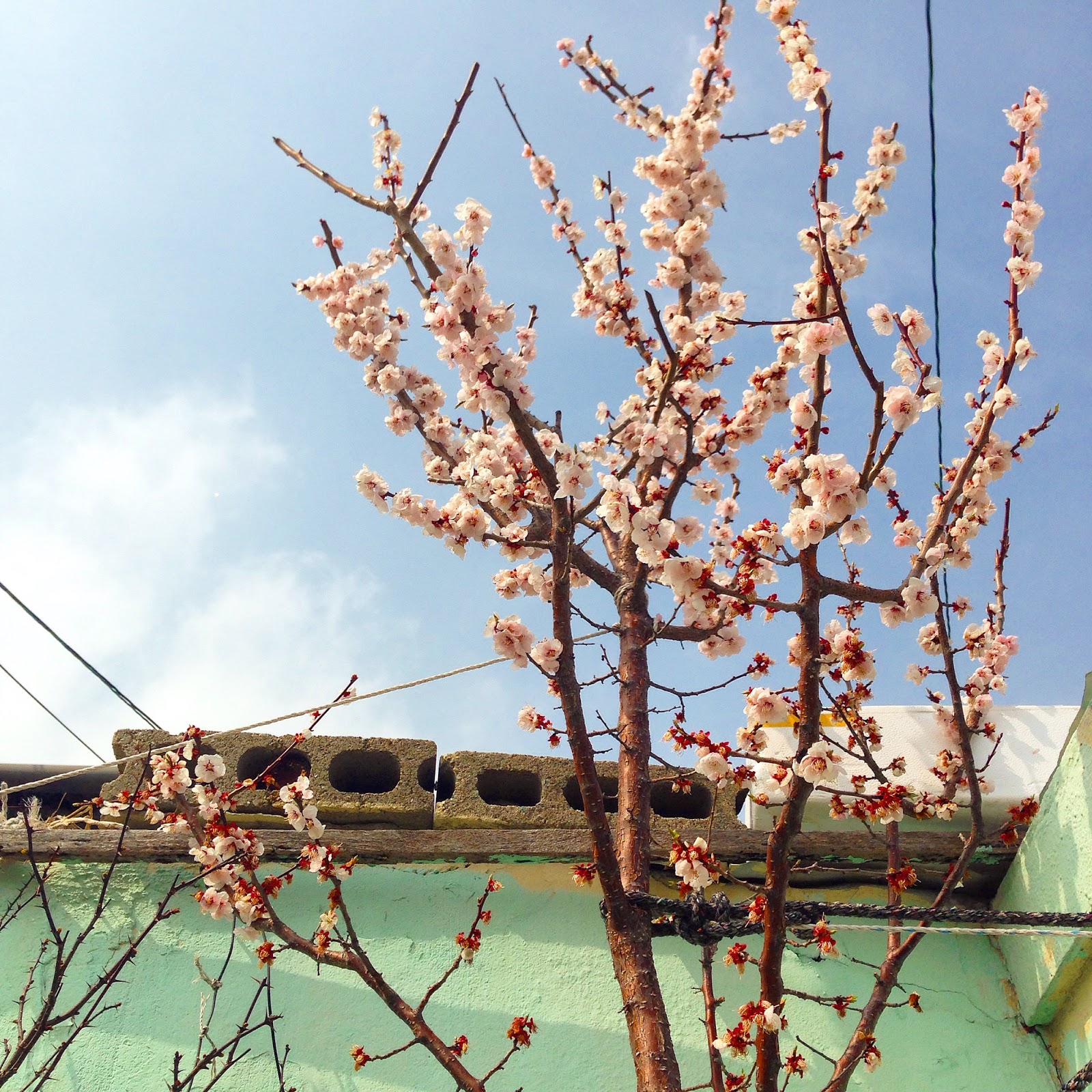
My first time to see cherry blossoms!! Too bad we weren't able to catch them in full bloom :(


Taking in the view of the colorful Lego-block houses :)

We had a great time going around this quirky, artsy village. It's really admirable how the combined efforts of the government and artists were able to convert an old slum area into this living art space that the locals and tourists alike could enjoy.

Entrance Fee:
N/A

Address:
177-11, Gamnae 2-ro, Saha-gu, Busan


How To Get Here:
Take Subway Line 1 to Toseong Station, go out through Exit 8.

Walk straight ahead until you see the bus stop (you will see the PNU Cancer Center to your right)

Take the Mini Bus 2 or 2-2 and prepare for what will probably be one of the most nausea-inducing rides of your life haha. It's a 15 minute ride with a lot of twists and turns through the hilly slopes of Gamcheon, but all the pretty and happy colors you see once you get off the bus will all be worth it :D

1st Night: Busog in Busan

   Our first stop in our Korean adventure was Busan- South Korea's 2nd largest city known for its beaches, mountains and temples. We spent two nights here and what I loved most about Busan was the fact that people there are so friendly to foreigners! We had several lost and confused moments and I couldn't count how many times people offered to help us out; some even went out of their way just to make sure we got to our destinations. Also, if you enjoy a relaxed city vibe you'll love it here. Another bonus- the food here is cheaper than in Seoul. We would usually order food for sharing during meals and most of the time, it would only cost us around Php 500- Php 700 per meal.

   Our Cebu Pacific flight left Manila on time (4 pm) and we touched down at Gimhae International Airport at around 9 in the evening. After clearing customs and getting our checked in luggage, we took the subway (to find it, exit the airport, cross the street and turn right. From there you will see the train station) from the airport to our Air BnB home.

   It was quite late when we were finally able to settle down, but all that waiting in NAIA made us hungry so we got right down to our first order of business: hunting for Korean food!! Our friendly Air BnB host Jason told us to hurry down to this local neighborhood restaurant if we wanted to eat- at that time of night, it was the only place that was open and would also be closing by midnight.

   A few things to note about eating out in local Korean restaurants- a lot of them don't have English menus, and if you're not in a particularly touristy area, they don't have pictures on the menu either. Doing a little bit of research beforehand on what you'd like to eat will surely help.
 With my friend Belle

Notice those aluminum lids on the tables? You can find the utensils inside (most of the time it's just chopsticks and spoons, ask for a fork if there isn't one)

Freshly prepared kimbap. Sooo good- really flavorful and the texture is just perfect!


Tonkatsu, ramyeon and kimbap. Love kimchi? Side dishes can be refilled, just ask your food server. Restaurants also provide drinking water for free :)

Mission number 1 (to eat local food ASAP) definitely accomplished! 

I will be posting about the Gamcheon Art Village, Jagalchi Fish Market, and BIFF (Busan International Film Festival) Square in my next entries :)  

Sunday, March 27, 2016

South Korea travel diary: Part 1- Travel Primer

Annyeong haseyo! We just came back from a short vacation in the land of kimchi and K pop and I must say we really had a blast! South Korea was everything I expected it to be and more. For fans of K dramas, K beauty and Korean food, a trip to Korea would be something like a pilgrimage one has to make.  Are you planning to visit Korea soon? Read on for more details on what to see, where to go and how to get there!


We got promo tickets for this trip last September 2015 but weren't able to meticulously plan for it because we just started processing our Korean visa requirements the same week we had to fly there. Not exactly a great move but to our defense, our passports got held up somewhere else in another embassy. We didn't want to do any planning until we were sure we could fly! 

We booked our Air BnB rooms on the day same day we left, and surprisingly, we still managed to find a lot of great places at really affordable prices. We flew in via Busan (Gimhae Airport), stayed there for 2 nights, took the express train going to Seoul where we stayed for a few more nights. We flew back to Manila via the Incheon Airport in Seoul.


Gamcheon Culture Village in Busan


 Spicy street food for the cold weather- tteokbokki, gyoza, gimbap


I'm happy to say we were able to make the most of this visit- we covered most of the popular tourist attractions like the grand palaces (Gyeongbokgung and Changdeokgung), a traditional Korean village (Bukchon Hanok Village), the N Seoul Tower, Nami Island, Hongdae, and the shopping districts (Myeongdong, Insadong, Dongdaemun). 

In Busan, we visited the Gamcheon Art Village, BIFF Square, and the Jagalchi Fish Market. No theme parks because it really isn't our thing, and due to time constraints we didn't go to the DMZ as well. 


Colorful declarations of love


Nami Island, as romantic in real life as it is on K dramas

                 
Sun setting over the N Seoul Tower


Before sharing with you our itinerary and budget sheet, here's a little travel primer so you know what to expect when planning a trip to Korea.


Links to other parts of this series:


BUSAN:

SEOUL:


Visa requirement: 

Yes, for Philippine passport holders. The Korean embassy is located at 122 Upper McKinley Road, McKinley Town Center, Fort Bonifacio, Taguig City. 

Visa processing takes 3-4 working days for frequent travellers or those with visits to the OECD member countries for the past 5 years, and 5 days for first time applicants. For those in the provinces, personal appearance is not required but make sure that all requirements are current and complete. We processed our visas with the help of a travel agent since we live in Iloilo City. 

Download the visa application form here: http://www.mofa.go.kr/english/visa/images/res/visakorean.pdf


And prepare the following documents found here:

http://embassy_philippines.mofa.go.kr/english/as/embassy_philippines/visa/requirement/

Currency: Korean Won (KRW). 


KRW 1 = PHP 0.04. Sounds confusing? For the mathematically challenged like me, an easy benchmark for this is that KRW 10,000 is roughly equal to PHP 400. This helped a lot, because I didnt have to whip out my calculator before deciding if something was too expensive.


Flight duration: (Philippines to South Korea): average of 3 hours and 45 minutes


Time difference: South Korea is one hour ahead of Philippine time


Weather:

Korea has four distinct seasons:

Winter: 


November to March- Ok to visit if you enjoy really cold weather and snow. January is considered the coldest month, so arm yourself with clothes, coats and warm accessories such as scarves, beanies, gloves and ear muffs.


We stayed from March 18-23, the skies were sunny and spring was already starting but the winds were still quite chilly, and temperatures tend to drop during late afternoons and evenings. Temps ranged from 2 deg C to 19 deg C. I brought light spring coats, thermals and sweaters that are easy to layer depending on the temperature.


Spring: 

April to May- still fairly cold with sunny skies. This is the best time to visit if you want to see the cherry blossoms in full bloom.

Summer: 

June to August- Summers are hot and humid; it is also the start of monsoon season so heavy rains are expected in between.

Autumn: 

September to November- also said to be a very good time to visit Korea, as the fall season carries with it beautiful weather and spectacular foliage. Several festivals are also held during this period

Signs of spring! :)

Outlet Type:


Type F power plugs and sockets are used.


Connectivity:


There was no need to buy a local sim card as there are a lot of open wifi connections both in Busan and Seoul, and almost all hostels/hotels provide wifi access as well. In Seoul, our Air BnB host provided us with a wifi egg (portable router) for free which we took with us when we went out so we had unlimited internet access. Useful for those times we needed to consult google!


Useful Apps:

If there is only enough space for one extra app on your phone/tab, make it the Subway Korea app. A must-download lifesaver! I don't know how we could have survived without it. Sure, the printed MRT map is OK but the Seoul subway network is so expansive (just imagine HK or SG subway system then multiply it by 10), it's difficult to locate the name of a certain station unless you are very familiar with the subway lines. With Subway Korea, you just click on your departing station, then search for the station you are supposed to arrive at, and voila! The app provides you with a route that will get you there the fastest, and with the least transfers.


Other Guides:


We took printed tourist booklets from airports and from various tourist information centers located in the city. I also did some research on www.seoulistic.com for Korea travel tips from a local.


Transportation Card:


Get a T-money or CashBee card (KRW 2,000) to make train and bus rides a breeze. This does away with the hassle of having to purchase single journey tickets each time you take a ride. You can also use these cards to pay for transactions at convenience stores and at major retailers.


 This is it for the first part, I hope this was helpful :) Itinerary and budget will be shared in the next posts.


What is your number one bucket list thing to do in Korea? Share with me on the comments below!